Sailing guide
Sailing in Croatia: A Practical Guide
Croatia suits a first sailing holiday well: a long, sheltered coast, islands a few hours apart, a dependable summer breeze and a choice of trip styles, from a cabin on a skippered yacht to a whole yacht you sail yourself. This guide covers the regions, the ways to sail, the season, conditions and costs, so you can understand the options before looking at any particular trip.
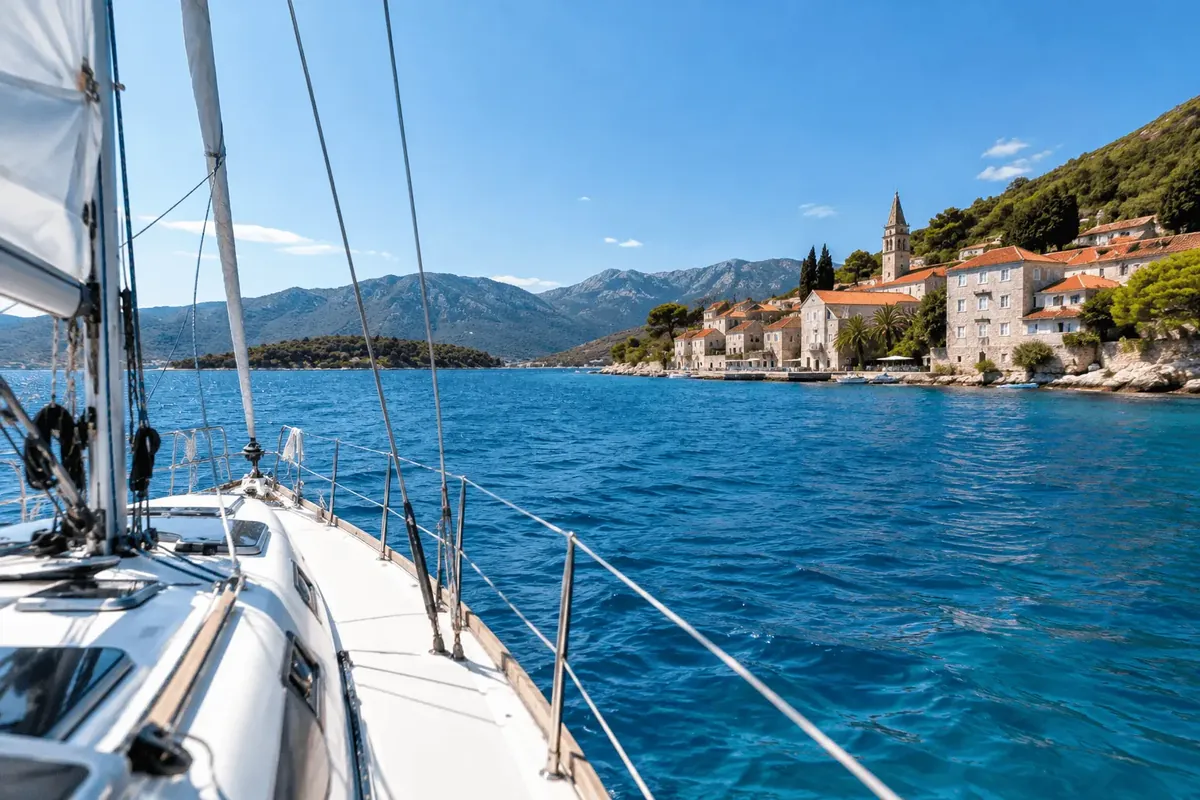
The coast and its sailing regions
Croatia's Adriatic coast runs from the Istrian peninsula, close to Slovenia and Italy, down to the border with Montenegro beyond Dubrovnik. Offshore lie more than a thousand islands, islets and reefs, most of them lying parallel to the mainland. That geography is what makes the coast so good for sailing: the channels between islands give shelter, and the next harbour is rarely more than a few hours away.
- Istria. A green, rolling peninsula with Venetian-era towns such as Rovinj and Poreč, the Roman amphitheatre in Pula and the Brijuni National Park. There are few islands, so most sailing is along the open coast.
- Kvarner. The gulf around Rijeka, with the large islands of Krk, Cres, Lošinj and Rab. Pine-covered bays face the Velebit mountains, where the bura wind blows hardest.
- Northern Dalmatia and Kornati. From Zadar to Šibenik, including the bare, stony islands of the Kornati National Park, the Telašćica Nature Park and the Krka estuary. Remote and quiet, with few towns.
- Central Dalmatia. The busiest sailing area, centred on Split. Brač, Hvar, Šolta and Vis are each within a day's sail, with stone towns, fishing villages and beach bars close together.
- The Dubrovnik area. Korčula, the Pelješac peninsula, Mljet National Park, Lastovo and the Elaphiti islands, ending at the walled city of Dubrovnik. Distances are longer and anchorages quieter.
Ways to sail
There are five common ways to spend a week on the water. They differ mainly in who sails the yacht and whether you share it.
| Style | Who sails | What you book |
|---|---|---|
| Skippered charter | A professional skipper | A whole yacht for your group |
| Bareboat charter | A qualified sailor in your group | A whole yacht with no crew |
| Cabin charter | A professional skipper | A cabin or berth on a shared yacht |
| Flotilla | You or a hired skipper, guided by a lead crew | One yacht within a group sailing together |
| Small-ship cruise | A full professional crew | A cabin on a larger motor vessel |
Bareboat charter requires a recognised skipper's licence and a VHF radio certificate within the crew. Every other style can be done with no sailing experience at all. For detailed comparisons, see skippered versus bareboat charter and a sailing week versus a small-ship cruise.
The sailing season
Most charter yachts operate from around April or May until October. July and August are the peak: warm sea, long days, a reliable afternoon breeze, full harbours and the highest prices. June and September are popular with regular sailors for their warm water and more space in harbours. May and October are quieter again, with cooler water and a greater chance of unsettled weather. The best time to sail in Croatia goes through the season month by month.
How a sailing week works
Charter weeks commonly run Saturday to Saturday from a base marina. You board in the afternoon, settle in and usually set off the next morning. The days then follow a loose pattern: a morning swim, a few hours of sailing to the next island, a lunch stop in a bay, and an evening in a harbour, on a mooring buoy or at anchor. Most routes are loops that end back at the base marina on the last evening.
The skipper adjusts the plan to the wind and forecast each day. Life on a sailing yacht explains cabins, meals, water, power and the skipper's role.
Conditions and safety
The Adriatic is a sheltered sea with very small tides. In summer the dominant wind is the maestral, a north-westerly breeze that builds in the late morning and fades by evening. Two other winds matter. The bura is a cold, gusty north-easterly that can arrive quickly, and the jugo is a warm south-easterly that builds over a day or two and brings swell and cloud. Both are more common outside high summer.
Sailing conditions covers winds, forecasts, marinas, buoys and protected areas. The safety guides cover swimming from the yacht, sun and heat, and moving around on deck. On any trip, the skipper's briefing comes first.
What it costs, in general terms
The headline price is only part of the total. A charter price usually covers the yacht, and a cabin price covers your berth. On top of that come some or all of these: food and drink (often through a shared kitty), fuel, marina and mooring fees, tourist tax, national park entry, transfers and a tip for the crew. What is included varies widely between operators, so compare total costs rather than headline prices. The cost of a sailing holiday in Croatia explains each item.
Where to go next
If you are early in your research, start with planning a sailing trip. If your week revolves around summer events, read festivals and nightlife.
This guide is general information about sailing in Croatia. If you are considering a trip with Croatia Sailing Week, the routes and dates and prices pages hold the confirmed details for those trips.
Planning
13 guidesLife on board
8 guidesSailing conditions
7 guidesFestivals and nightlife
5 guidesSafety at sea
6 guidesKeep reading
Tell us your dates, your group size and the islands you would like to see, and we will reply with suitable options and a written quote.