Destination guide: southern Dalmatian islands
Sailing in Korčula
Korčula Town is one of the best-preserved walled towns on the Adriatic, packed onto a small peninsula with the sea on three sides. The island behind it is green with pine and vineyards, and it is known across Croatia for its white wines.
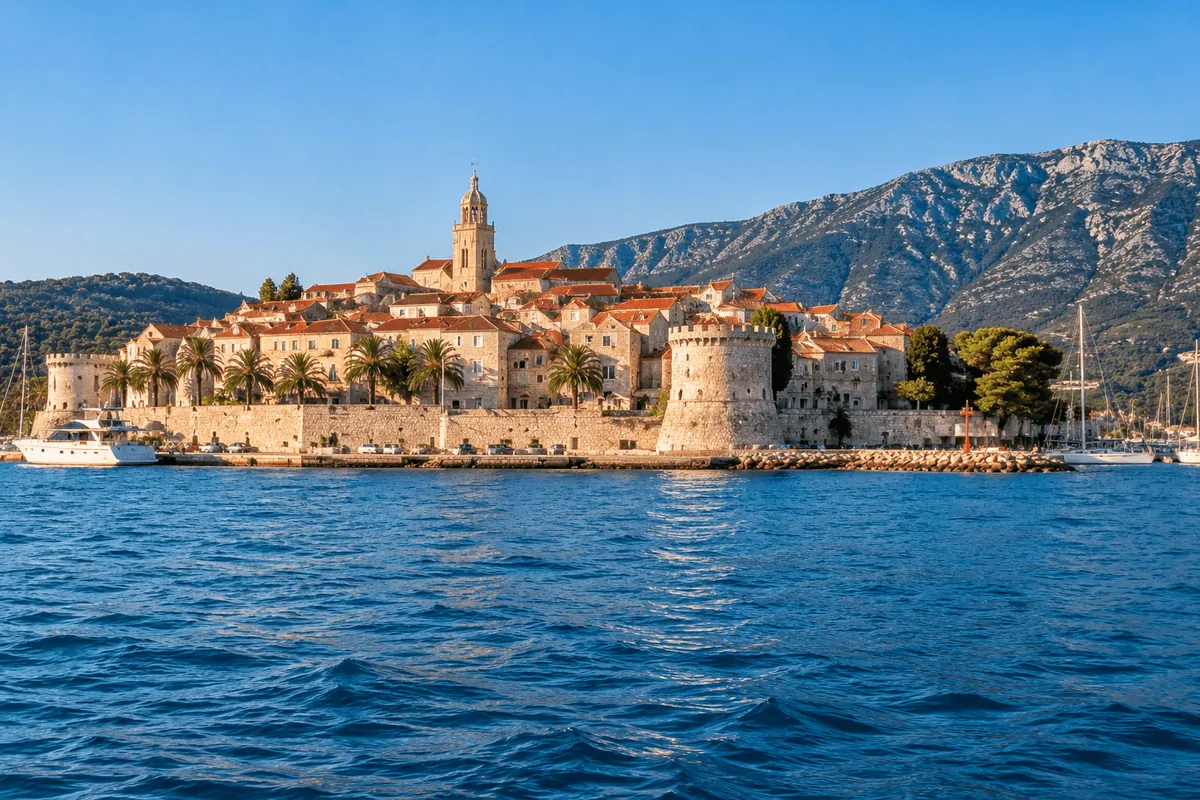
Arriving by sea
From the water, Korčula Town looks almost like a model: a tight oval of stone roofs ringed by walls and round towers, rising to the bell tower of St Mark's Cathedral at its highest point. Across the narrow channel, the mountains of the Pelješac peninsula rise steeply behind the town of Orebić. East of town lie the Škoji, a cluster of small islets, among them Badija with its old Franciscan monastery.
The Pelješac channel funnels the summer north-westerly, so the approach can be breezy in the afternoon, which makes for some of the best sailing of the week.
A short history
The ancient Greeks called the island Korkyra Melaina, Black Corcyra, after its dark pine forests and to tell it apart from Corcyra, today's Corfu. The town took its present shape in the Middle Ages, much of it under Venetian rule. Its builders laid the streets out in a herringbone pattern off a central spine, so that cooling breezes could flow through while the strongest winds and the summer sun were kept out.
Walls and towers once enclosed the whole peninsula, and building outside them was forbidden until the 18th century. Several towers still stand, including the Revelin at the Land Gate. Korčula also claims Marco Polo as a native; the claim is disputed, but the town celebrates it with a house and museum in his name.
A few hours ashore
The old town is small enough to cover in a couple of hours, but rewards a slower evening wander:
- Walk the perimeter along the old sea walls, watching the light change over Pelješac, then cut up the side lanes into the centre.
- St Mark's Cathedral, built over several centuries in Romanesque and Gothic styles, with a richly carved doorway and a bell tower you can climb.
- The Land Gate and Revelin tower, the grand main entrance to the old town at the top of a broad flight of steps.
- Moreška, a sword dance dating back to the Middle Ages, in which two kings fight for a princess. Performances are held for visitors through the summer; check locally for days and times.
For a change of pace, Lumbarda, a short drive east, is a village of vineyards and sandy coves.
Swims and bays nearby
The Škoji islets just east of town give sheltered swimming within easy reach. Badija, the largest, has pine woods and clear water. Vrnik, a tiny islet with old stone quarries, has a small village and a quiet atmosphere. Lumbarda has some of the island's few sandy beaches, rare on this rocky coast. Further west, the long bay of Vela Luka and the coves along the south coast are quieter and less visited.
Food and wine
Korčula's wine is a large part of its identity. Pošip, a crisp, aromatic white, is grown around the villages of Čara and Smokvica in the island's interior. Grk, a rarer white, grows mainly in the sandy soils around Lumbarda. Both go well with grilled fish and shellfish.
From Žrnovo, just inland of the town, come žrnovski makaruni, hand-rolled pasta usually served with a rich meat sauce. Look too for cukarini, the island's traditional sweet biscuits.
How yachts berth on Korčula
The town has an ACI marina beside the old walls, a few minutes' walk from the gates, and quay space along the walls themselves. Both can be exposed to the wind funnelling through the channel. Lumbarda has a small marina, and Vela Luka a long, sheltered bay with quay space. Around the Škoji islets, yachts anchor or use buoys for lunch stops.
In a strong wind your skipper may choose a more sheltered spot and arrange a water taxi or short walk into town. Our guide to marinas and town quays explains the options.
Practical notes
July and August bring day-trippers on catamarans and excursion boats, so the old town is quietest early in the morning and late in the evening. Its lanes are stepped and polished smooth, so wear shoes with grip. Cards are widely accepted in town, but take cash for smaller places in the villages. Mljet National Park and Lastovo Nature Park lie nearby; both charge entry fees, which our guide to national and nature park fees explains.
Responsible visiting
People live inside the old town walls, and sound carries in the narrow lanes, so keep voices down late at night. Anchor on sand around the Škoji islets, clear of the Posidonia seagrass in the shallows; see our guide to protecting seagrass when anchoring. Follow the rules in the nearby protected areas, and take rubbish back to a harbour with bins.
Questions
Why does Korčula have a herringbone street plan?
The streets run off a central spine at angles that let cooling breezes through while blocking the strongest winds and the midday sun.
Was Marco Polo born in Korčula?
The town claims him as a native, but historians dispute it. Either way, the Marco Polo house is a pleasant stop in the old town.
What wines is Korčula known for?
Pošip, grown around Čara and Smokvica, and Grk, grown mainly around Lumbarda. Both are white.
Other destinations
Plan your visit
Tell us your dates, your group size and the islands you would like to see, and we will reply with suitable options and a written quote.