Destination guide: central Dalmatian islands
Sailing in Šolta
Šolta is the small island closest to Split, yet it feels far quieter than its neighbours. It is a place of olive groves, stone villages and sheltered bays, where life still follows the rhythm of fishing and farming, and it makes a calm first or last stop near the city.
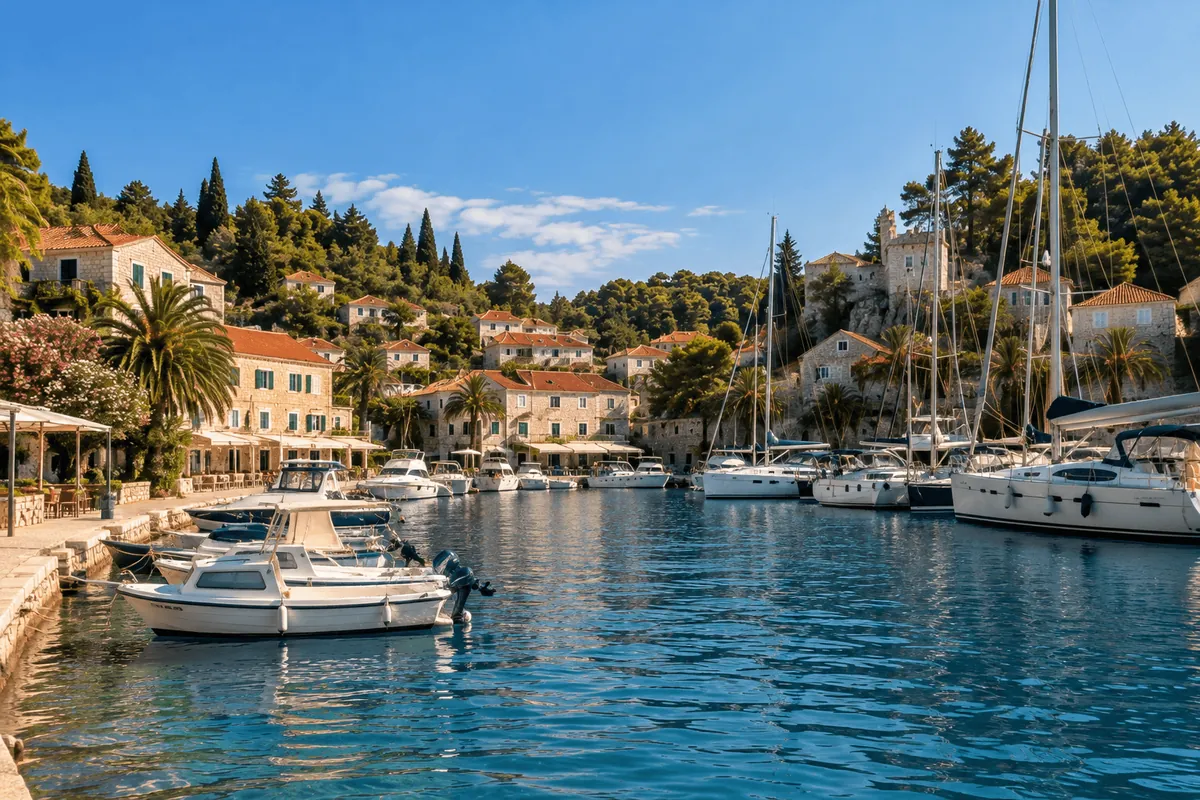
Arriving by sea
Šolta lies just south-west of Split, separated from Brač by a narrow strait called the Split Gate (Splitska vrata). It is low and green compared with its bigger neighbours, its highest point barely over 200 metres. From the water you see olive terraces and pine woods running down to the shore, with small harbours tucked into the bays.
The north coast faces the mainland, with deep inlets at Rogač, Nečujam and Stomorska. The west end has Maslinica, a fishing harbour sheltered by a scatter of small islets. The south coast is steep and wild, with only a few coves to break it up.
A short history
Vines and olives have grown on Šolta since antiquity, and the island's villages grew up inland, away from raiders, with the harbours coming later. Grohote, the oldest and largest village, is still the island's administrative centre, a cluster of stone houses, wine cellars and outside stone staircases.
The island's best-known grape, Dobričić, turned out in DNA studies to be one of the parents of Plavac mali, the main red grape of the Dalmatian coast. In the Second World War, Šolta was occupied and saw British and American commando raids in 1944. Maslinica's baroque castle, built by the Marchi family who settled the harbour, is now a hotel.
A few hours ashore
Šolta suits a slow afternoon or evening ashore:
- Maslinica: a small harbour with a waterfront of stone houses and restaurants, and the castle by the water. Sunsets over the islets are a highlight.
- Stomorska: a pretty fishing village on the north coast, with a long, quiet quay and cafés.
- Grohote: walk up from Rogač through olive groves to see the island's oldest village, its church and its stone lanes.
- Nečujam: a wide bay with several smaller coves, pine shade and simple beaches.
Local producers sell olive oil, honey and wine from their homes and at small stalls. A bottle of Šolta olive oil or a jar of honey makes a good souvenir.
Swims and bays nearby
The islets off Maslinica give clear, sheltered swimming, and the bay of Šešula, just south of the harbour, is a popular lunch or overnight stop with restaurants on the shore. Nečujam's coves are good for an afternoon swim and snorkel. On the steep south coast, Livka is one of the few inlets, best visited in settled weather with no southerly wind.
Food and wine
Šolta's olive oil is the island's pride, pressed from groves that cover much of its land. Its honey, often from rosemary and wild herbs, is just as well known. Dobričić, a dark red grape grown on the island, gives deeply coloured wines; it is rarely found elsewhere, so look for it in local konobas. Fish caught by local boats, often simply grilled with olive oil and garlic, is the main thing on most menus.
How yachts berth on Šolta
Maslinica has a marina and mooring buoys in its sheltered harbour, and Šešula bay has buoys run by the restaurants. Stomorska has a town quay along its inlet. Nečujam has bays where yachts anchor or use buoys. Rogač is the ferry harbour, so space for yachts there is limited.
Because Šolta is so close to Split, it often works as a first or last night of a week, when a short sail is all that is needed. Whether a week stops here depends on the route, so ask us when you enquire. Stops can change with the weather. Our guide to anchoring and mooring buoys explains how buoy fields work.
Practical notes
Šolta is quiet even in July and August, though the popular bays fill with yachts on summer evenings. Facilities are simpler than on Hvar or Brač: there are small shops in the main villages, but fewer cash machines, so carry euros as well as cards. Distances are short, but the villages are spread across the island, and the walk from the harbours to Grohote is uphill.
Responsible visiting
The bays around Šolta shelter wide Posidonia seagrass meadows, which keep the water clear and give fish a nursery. Use mooring buoys where they exist and anchor on sand elsewhere; our guide to protecting seagrass when anchoring shows how. The island's communities are small, so keep evening noise in the bays down, and buy from local producers when you can. Take rubbish back to a harbour with bins.
Questions
Is Šolta worth visiting if it is so close to Split?
Yes. It feels much quieter than the city or the bigger islands, with calm bays, simple village restaurants and good local olive oil, honey and wine.
Where do yachts usually stop on Šolta?
Maslinica and Šešula on the west coast, and Stomorska and Nečujam on the north coast, depending on the wind and how busy they are.
What is Dobričić?
A red grape native to Šolta and one of the parents of Plavac mali, the main red grape of the Dalmatian coast.
Other destinations
Plan your visit
Tell us your dates, your group size and the islands you would like to see, and we will reply with suitable options and a written quote.