Destination guide: central Dalmatia
Sailing in Split
Split is Croatia's second city and the main sea gateway to the central Dalmatian islands. Its old town grew up inside a Roman emperor's palace, and since many sailing weeks in the region begin or end in or near the city, it rewards a day of your own before or after time on the water.
Arriving by sea
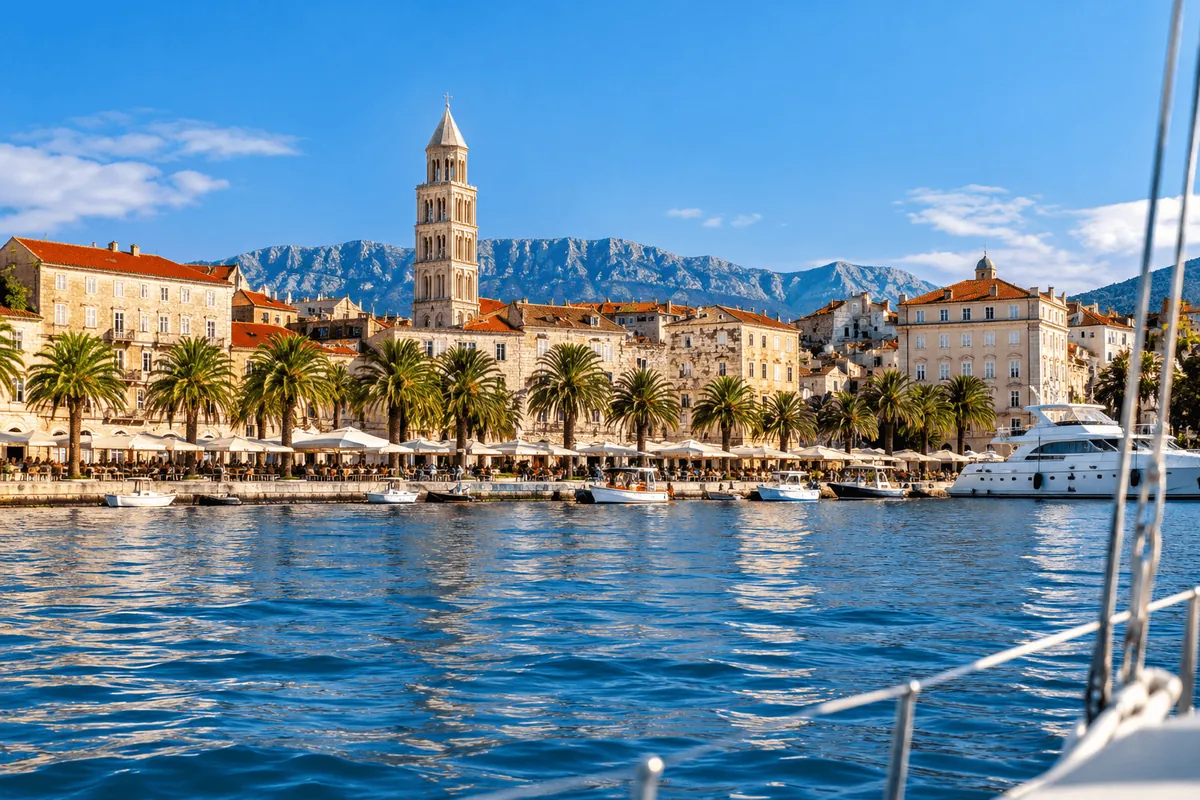
Coming in from the islands, Split shows itself in layers. The wooded slopes of Marjan hill rise on the western side of the city, the bell tower of the cathedral stands above the rooftops of the old town, and the palm-lined Riva runs along the waterfront in front of the palace walls.
The harbour is one of the busiest on the Adriatic. Car ferries and fast catamarans run to the islands all day, so expect a lot of traffic and wash as you approach. Your skipper will keep clear of the ferry lanes and has to give way to large vessels manoeuvring in the port.
A short history
The Roman emperor Diocletian built his palace here around the turn of the 4th century AD, as a fortified retirement residence close to Salona, then the capital of the Roman province of Dalmatia. When Salona was sacked in the 7th century, its people took refuge inside the palace walls and built a town within them.
That town never moved out. Medieval houses, churches and squares fill the old Roman street grid, and people still live and work inside the walls. Diocletian's mausoleum became the Cathedral of St Domnius. Later Venetian and Austrian rule added squares and palaces just west of the walls. The historic centre, palace included, has been a UNESCO World Heritage Site since 1979.
A few hours ashore
The old town is compact, and you can see the essentials on foot in a morning:
- The Peristyle, the palace's colonnaded central courtyard, and the Cathedral of St Domnius beside it. Climb the bell tower for a view over the rooftops and harbour.
- The substructures, the vaulted halls under the palace, which show its original floor plan.
- The Golden Gate, the palace's northern entrance, where Ivan Meštrović's huge statue of Bishop Grgur Ninski stands. Rubbing his big toe is said to bring luck.
- The green market and the fish market, best early in the morning, for a look at what is in season.
For a break from the stone streets, walk up Marjan. Steps from the Varoš neighbourhood lead to a viewpoint over the city and islands, and paths continue through the pines to small coves on the far side of the hill. Bačvice, a shallow sandy beach close to the ferry port, is where locals play picigin, a game of keeping a small ball in the air while standing in the shallows.
Food and wine
Split's food is Dalmatian at heart: grilled fish, octopus, black risotto and simple vegetables dressed in olive oil. For something more local, look for pašticada, beef slow-cooked in a sweet and sour wine sauce and served with gnocchi, and soparnik, a thin pie of Swiss chard from the Poljica area just south of the city.
The wine bars in the old town pour bottles from across Dalmatia. Plavac mali is the main red grape of the coast, and Pošip a popular white. Look out too for Crljenak kaštelanski, an old local grape from the Kaštela area next to Split that turned out to be the same variety as Zinfandel. Our guide to Croatian food to try by the sea has more.
How yachts berth in and around Split
There are several places to keep a yacht in the Split area. The ACI marina sits at the foot of Marjan on the western side of the city harbour, a walk along the waterfront from the Riva. There are also large marinas along the coast towards Kaštela, Trogir and Seget, where many charter fleets are based.
Marinas here work in the usual Mediterranean way: yachts moor stern-to the pontoon, held at the bow by a lazy line, with water and shore power on the dock. The ferry port is for commercial traffic. For how this works in practice, read our guide to marinas and town quays.
Practical notes
Split Airport lies west of the city, between Kaštela and Trogir, and is connected to the centre by bus and taxi. Our guide to getting to the marina in Split covers the options. The main bus station, train station and ferry port sit close together on the eastern side of the harbour, a short walk from the palace.
July and August are busy, especially when cruise ships are in port. See the palace early in the morning or in the evening, when the crowds thin. The city fills up in July around the Ultra Europe festival, so book accommodation early if you are arriving that week.
Croatia uses the euro. Cards are widely accepted, though some smaller cafés and market stalls prefer cash.
Responsible visiting
The palace is a neighbourhood as well as a monument. Keep noise down late at night in its narrow streets, and cover up away from the beach: local rules allow fines for walking around the centre in swimwear.
Once you leave the harbour, the bays around Šolta and Brač shelter meadows of Posidonia seagrass, which keep the water clear and are slow to recover from anchor damage. Read about protecting seagrass when anchoring, take rubbish ashore to the marina bins, and use fresh water sparingly once you are on the islands.
Questions
Is it worth spending a day in Split before a sailing week?
Yes. The palace, the Riva and Marjan hill fill a relaxed day, and arriving early takes the stress out of flight delays.
Can you swim in Split?
Yes. Bačvice is the closest beach to the centre, and the coves around Marjan hill are quieter and reached on foot or by bike.
Where do yachts depart from in Split?
Yachts are based in the city's marina and in marinas along the coast towards Kaštela and Trogir. Your booking confirmation gives the exact marina and check-in time.
Other destinations
Plan your visit
Tell us your dates, your group size and the islands you would like to see, and we will reply with suitable options and a written quote.