Destination guide: central Dalmatian islands
Sailing in Hvar
Hvar is a long, narrow island south of Brač, and it has two very different sides. Hvar Town is a lively Venetian harbour with a fortress above it and the Pakleni islands in front, while Stari Grad, Jelsa and Vrboska on the north coast are calmer towns with older roots.
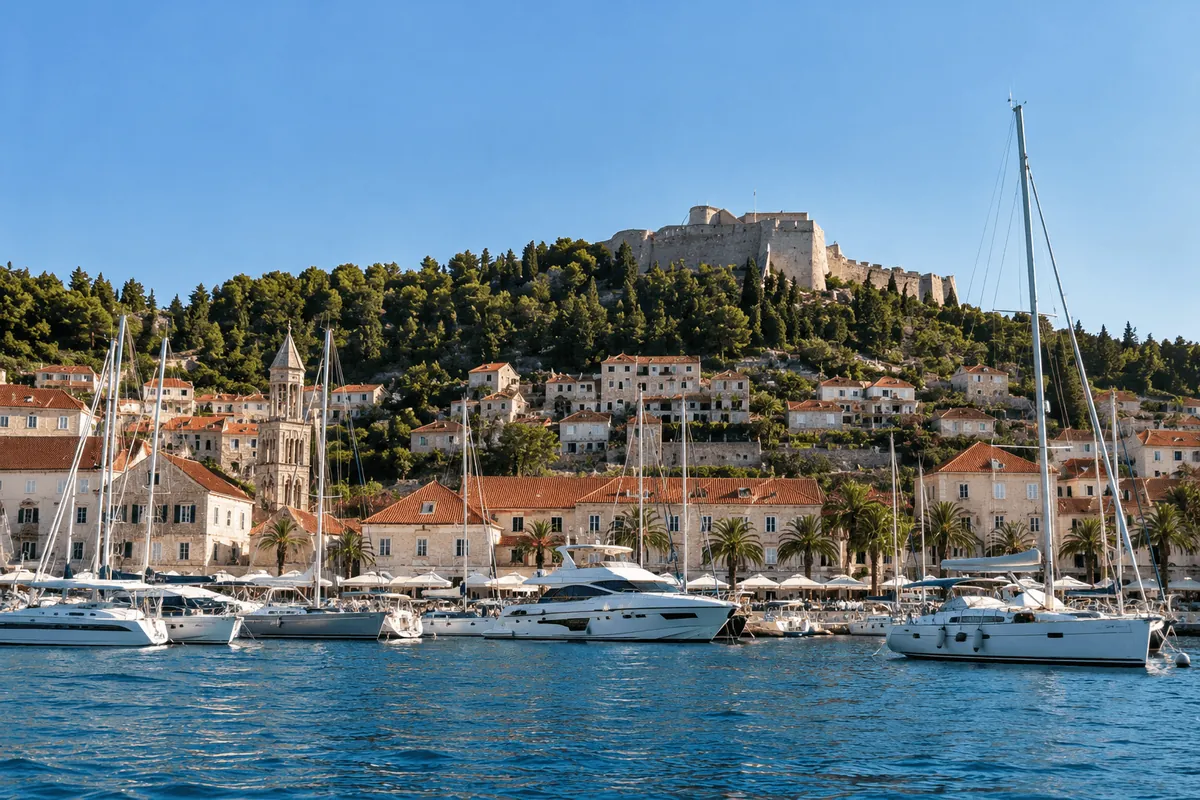
Arriving by sea
Approaching Hvar Town from the south, you pass through the Pakleni islands, a scatter of low, pine-covered islets that shelter the harbour. The town opens up as you round them: a horseshoe of stone houses climbing the hillside, the bell tower of the cathedral at the head of the harbour, and the Fortica fortress on the ridge above.
The north coast feels completely different. Stari Grad lies at the end of a long, narrow inlet, and Vrboska sits on a small creek crossed by bridges. Both are quieter places to arrive, with the island's farmland and vineyards behind them.
A short history
Greek settlers from the island of Paros founded Pharos, today's Stari Grad, in 384 BC. They divided the fertile plain behind the town into regular plots bounded by stone walls, and that field system is still farmed. The Stari Grad Plain has been a UNESCO World Heritage Site since 2008.
Under Venice, Hvar Town became the island's main town and an important naval station. The fortress above it was rebuilt after a gunpowder explosion in 1579. In 1612 a public theatre opened on the first floor of the Arsenal, where Venetian galleys were repaired, making it one of the oldest public theatres in Europe.
A few hours ashore
In Hvar Town:
- The main square (Pjaca), the largest square in Dalmatia, running from the harbour up to St Stephen's Cathedral.
- The Arsenal and theatre, on the waterfront beside the square.
- The Fortica, reached by stepped lanes and a path through pine woods behind the town. Go in the early morning or near sunset, when it is cooler and the view across the Pakleni islands is at its best.
- The Franciscan monastery, a short walk east along the shore, with a quiet cloister and gardens.
On the north coast, Stari Grad has a long waterfront and a tangle of old lanes. Tvrdalj, the fortified summer house of the 16th-century poet Petar Hektorović, has a fishpond in its courtyard. Jelsa has a pleasant harbour square, and Vrboska is small enough to walk round in an hour.
Swims and bays nearby
The Pakleni islands are the obvious swimming spot near Hvar Town, with clear water, rocky shores and small coves that work as lunch stops. Palmižana, on Sveti Klement, the largest of them, has a marina, restaurants and paths across the island to bays on the southern side. Some of the islets closer to town host busy beach clubs in summer; the further coves are calmer.
On the north side of the island, the bays around Stari Grad and Vrboska are more sheltered and less crowded, and suit an early morning swim before the wind picks up.
Food, wine and lavender
Hvar's steep southern slopes produce some of the strongest Plavac mali on the coast, and the north side grows Bogdanjuša, a light local white. Hvar gregada, a fish stew with potatoes and olive oil, is the island's signature dish, and you will find good grilled fish and lamb in the konobas of the inland villages.
Lavender has long been grown on the island's high plateau, and in early summer the fields flower purple. Small bottles of lavender oil and dried sachets are sold all along the waterfront.
How yachts berth on Hvar
Hvar Town has a town quay and mooring buoys in the harbour, but space is limited and it fills early in summer. Many yachts stay instead at Palmižana in the Pakleni islands and take a water taxi across to town for the evening. Stari Grad has a long town quay at the end of its inlet, and there is a marina at Vrboska as well as quay space in Jelsa.
Which option suits the night depends on wind, swell and how busy it is, and your skipper makes that call. Our guides to marinas and town quays and anchoring and mooring buoys explain the differences.
Practical notes
Hvar Town is at its busiest in July and August, especially in the evenings. If you want the nightlife, read our guide to Hvar nightlife; if you would rather avoid it, the north coast towns are much quieter.
The town centre is small and walkable, but the lanes up to the fortress are steep and stepped, so wear proper shoes. Cards are widely accepted in Hvar Town, while some smaller places in the villages prefer cash. Hvar Town has local rules on behaviour in public, including fines for walking around in swimwear away from the beach.
Responsible visiting
The Pakleni islands are a protected landscape. Anchor on sand, never on the Posidonia seagrass that carpets many of the bays, and use mooring buoys where they are laid; our guide to protecting seagrass when anchoring explains why. Fresh water is limited on the island, so keep showers short. In Hvar Town, keep music down when you are moored close to homes, and leave the town as you would want your own street left.
Questions
Is Hvar only for partying?
No. Hvar Town is lively in summer, but Stari Grad, Jelsa and Vrboska are calm, historic towns, and the inland villages are quieter still.
What are the Pakleni islands?
A chain of small wooded islands just off Hvar Town, popular for swimming and lunch stops. Palmižana, on the largest island, has a marina and restaurants.
Does every sailing route stop at Hvar?
Not necessarily. Ask us when you enquire, and remember that stops can change with weather and harbour space.
Other destinations
Plan your visit
Tell us your dates, your group size and the islands you would like to see, and we will reply with suitable options and a written quote.